

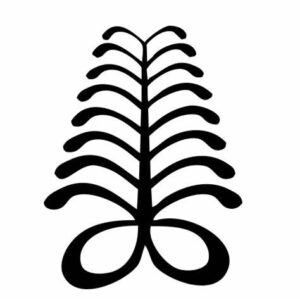
In poetry, since the foundation of the art itself, there has always been a constant struggle between the chaotic aspect of the art and the formal. The two Greek gods of poetry, Dionysus (the chaotic aspect) and Apollo (formal aspect), in every great poem battle for a poet’s ability to control their work.
Poems often use the formal, which is sound and the visual aspects of language, to control the chaotic, thus meaning and expression. The visual aspects of the language, from the use of sensory details or imagery to the shape of the poem on a page, function as a tool that carries the meaning of a poem.
In my poem ‘AYA’, which was inspired by the Adinkra symbol for fern in the Akan/Ashanti culture, I use the visual aspects of language to express the history & struggles of Black women through their hair as well as the important role and value of black hair. In this poem, themes include family, violence, resistance, and identity. It is written in free verse, spluttered with a lot of fast-moving images. Writers can help their audience attain a faster-paced reading simply by employing more verbs and verb clusters in their writing.
In all forms of writing, it is important to establish your rhetorical situation (Exigence + Purpose + Audience). There are a lot more rhetorical theories than these three, but these are the most important, at least to me. Purpose establishes your aim for writing, exigence, the ‘why’, and audience, to whom you are writing. This is and must be a part of every writer’s pre-writing activity. A well-established rhetorical situation provides a writer with a clearer and more measurable writing expectation/goal.
In ‘AYA’, my audience were the poetry community, students and instructors. I aimed to express and inform my audience and in response to the exigence, which was the celebration of Black History Month.